This is a continuation of the Resume 101 series. If you haven’t already, read through The Basics before reading further through this blog. This framework builds atop those concepts and is the next step to leveling up your resume.
Levels of Specificity
The “Levels of Specificity” framework is a tool students can use to assess and quantify the current strength of your bullet point. This framework is broken into 5 different levels with each step acting as a higher level from the previous, similar to a funnel.
After understanding the framework, you’ll know how to transform a bullet point from a “good enough” bullet into an “amazing” one.
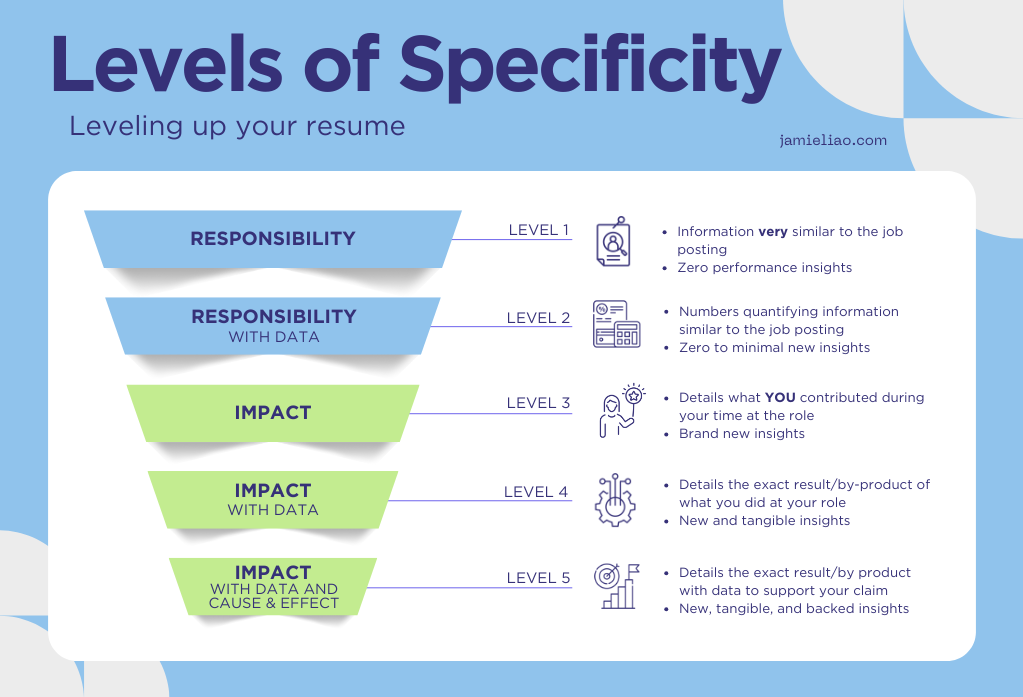
Due to the amount of information, this framework overview is broken up into 2 parts:
- Part 1 (this blog post) walks through Levels 1, 2, and 3 with detailed examples. These levels are arguably the most difficult, but also the most important levels. It completely transforms the type of information a bullet point is highlighting.
- Part 2 (coming soon) continues the walkthrough of Levels 4 and 5, plus a plan of action to begin leveling up your own resume.
Level 1
Starting from the top, Level 1 (and Level 2) falls into the “responsibility” category. From The Basics, a responsibility bullet point can be defined as:
- A list of tasks/responsibilities, typically found on the role description/job posting
- Provides the reader little to no additional insight on what the student did at the role, aside from doing what was already expected
Consider the following example resume bullet points from a baker working for a cupcake business:
Baker 1:
Made cupcakes for local school and community events.
Baker 2:
Customized cupcakes on request for local birthday parties. Both bullet points provide me no new insights about either baker and how they performed in the role. I’d completely omit this bullet point; it’s extra fluff that provides no useful (or even hurtful) information on a resume.
Level 2
Level 2 is slightly stronger than Level 1 because data can help quantify the scale of the responsibility or task done. The data can include number of items, time, etc. in any combination, and adding more types of data strengthens the bullet point. Consider the same baker examples:
Baker 1:
Made 100 cupcakes for local school and community events.
Baker 2:
Customized 1,000 cupcakes on request for local birthday parties.Compared to Baker 1, Baker 2 seems like they have more experience making cupcakes. However, it’s quite vague so I can’t use this bullet point as the full picture.
Baker 1:
Made 100 cupcakes each week for a year of local school and community events.
Baker 2: Customized 1,000 cupcakes on request for local birthday parties in a year.This time, I’m much more impressed with Baker 1 because they’re frequently and consistently baking large amounts of cupcakes. This exemplifies the baker’s dedication and efficiency.
An additional data point, such as time, adds another dimension to help quantify this baker’s work. However these bullets could be completely rewritten to detail their impact (Levels 3-5) while utilizing a similar word count. Thus, considering the opportunity cost and low value for the reader, these bullet points remain as Level 2.
💡 Level-by-level comparisons with the cupcake baker examples 💡
| Level | Baker 1 | Baker 2 |
| 1: Responsibility | Made cupcakes for local school and community events. | Customized cupcakes on request for local birthday parties. |
| 2: Responsibility w/ data | Made 100 cupcakes each week for a year of local school and community events. | Customized 1,000 cupcakes on request for local birthday parties in a year. |
| 3: Impact | ||
| 4: Impact w/ data | ||
| 5: Impact w/ data and cause & effect |
Level 3
This level is a large jump from Level 1 and 2 because it likely requires completely new aspect of your role, then writing a brand new bullet point. So, how do we differentiate between a “responsibility” or “impact”? Starting from Level 3, we shift into the “Impact” category from The Basics, which is defined as:
- Describes things YOU contributed during your time at the role. Ex: new projects, improvements, changes, etc.
- Provides the reader with extra insight into how you perform at your various roles.
The easiest way is to look up the job listing online, or a comparable one. Most job listings include a “responsibilities” section, which summarizes the list of tasks this person is expected to do. If you notice your resume’s bullet point is similar to any bullet on the job posting, then your bullet is a responsibility and needs workshopping. We’ll start by transforming the bullet points from Level 1 into an impact:
Baker 1:
Implemented supply chain of baking materials with wholesalers on a weekly basis.
Baker 2:
Created new form submission for clients to submit cupcake customization requests. These bullets signal to the reader that this person has made or created an impact in their role; this thing exists because of their efforts. These “impact” bullets go beyond simply doing what the baker was told in their role. They noticed an issue, an efficiency, a bottleneck, etc., then did something about it.
While deciding how to re-write an impact bullet point, it’s important to note that choosing good resume action words is extremely important for two reasons. First, these clear, familiar words carry significant meaning because they’re relatively standardized in resume writing. The word “Implemented” implies a person had talked to relevant stakeholders in the company, designed X thing, and made X thing happen in the larger team.
Second, action words signal/prime the reader for the entire bullet point’s information/context. For example, I expect different types of information for a bullet point that starts with “Expedited” and “Analyzed.” As a recruiter, if I’m looking for a candidate who has experience analyzing data, I’ll scan their resume for specific action words.
I further discuss these cognitive implications of using familiar terms in my Formatting & Style blog post.
💡 Level-by-level comparisons with the cupcake baker examples 💡
| Level | Baker 1 | Baker 2 |
| 1: Responsibility | Made cupcakes for local school and community events. | Customized cupcakes on request for local birthday parties. |
| 2: Responsibility w/ data | Made 100 cupcakes each week for a year of local school and community events. | Customized 1,000 cupcakes on request for local birthday parties in a year. |
| 3: Impact | Implemented supply chain of baking materials with wholesalers on a weekly basis. | Created new form submission for clients to submit cupcake customization requests. |
| 4: Impact w/ data | ||
| 5: Impact w/ data and cause & effect |
Conclusion
Leveling up your resume bullet points is a challenging task, so give yourself patience and don’t be discouraged. It still takes me many, many rewrites to get a single bullet point to a decent point. Stay tuned for Part 2, which walks through Levels 4 and 5, plus a plan of action to begin leveling up your own resume.
I have a Resumes 101 blog post series that break down key components of your resume:
Subscribe to my blog to get notified when I release new blog posts!
My goal is to break down technical concepts through the lens of educational psychology. If you’ve found my explanation or breakdown helpful, please let me know in the comments!
If you’d like to hear more about a specific topic, comment any topics below!
 Jamie Liao
Leave a comment