We all really suck at one thing: asking for help.
Asking for help is tough; it’s daunting and forces us to expose our vulnerabilities to a wave of potential criticism. Our brains unleash the flood gates of worst-case scenarios and that once potential criticism now materializes as guaranteed criticism.
“Just ask me if you need help” is something I’ve heard repeatedly as an undergrad in Data Structures, as a first-timer at hackathons, and as a full-time engineer. It’s incredibly daunting to muster up the courage to ask questions when my brain already expects someone to criticize me by saying “you should known this already.”
And regretfully, I’ve recently found myself regurgitating this exact phrase “just ask me if you need help” to others I’m mentoring or supporting whilst fully knowing the effects this phrase had on myself. This led me to question:
- Why do I believe saying “just ask for help” is good advice to offer when even I fear asking for help?
- How can I make your journey just a bit easier by offering actionable advice or guidance when encouraged to “ask for help”?
Why we fear asking questions
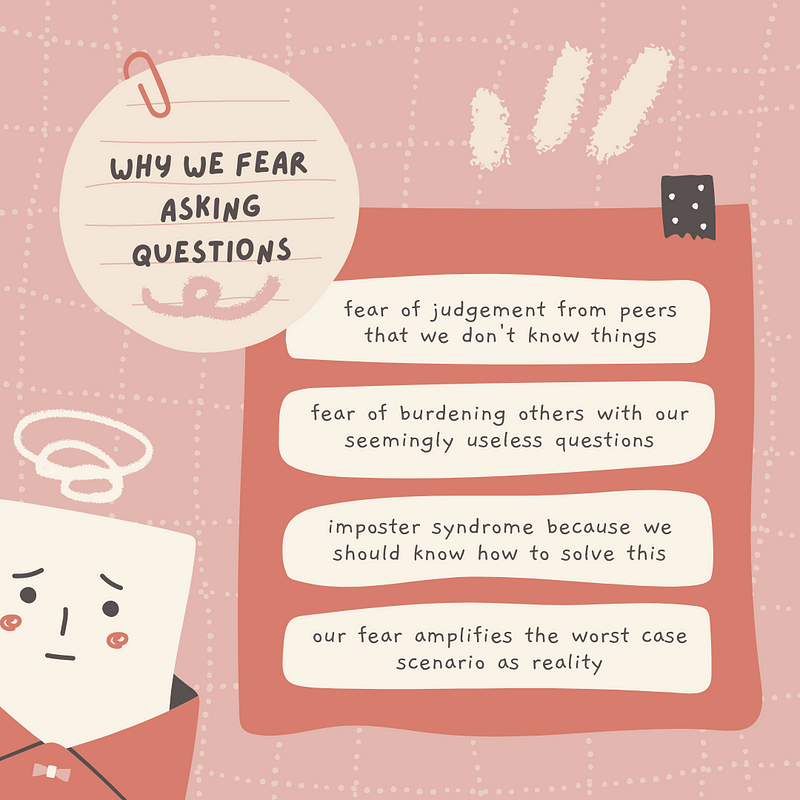
The first step in unpacking the answer to Question #1 is understanding why I fear asking for help. To list a few:
- fear of burdening others
- fear of looking dumb
- fear of my company finally discovering that I probably lied about everything on my resume and I don’t actually know shit, aka our lovely friend imposter syndrome : )
These are some of the millions of thoughts that go through my head as I attempt, and fail, to give myself a pep talk in preparation to “just ask for help.” The inner voice in my head becomes overrun by each of these fears, which may trigger a fight or flight response. In most cases, I chose flight.
This is a great podcast that discusses the power of fear on our decisions and future predictions of what could happen. TL;DR our fear amplifies the worst possible scenario (getting criticized) and mutes the most plausible scenario (receiving amazing guidance).
Why you should still ask for help
Asking for help is a form of acknowledgement that you aren’t expected to know everything and that you are working towards improving yourself.
Embrace this fear and acknowledge that your worst-case scenario situation will more than likely not become true because your predictions are skewed by fear. This is easier said than done, but it’ll get easier with each experience.

Overtime, I’ve learned that the advantages of asking for help truly far outweigh the potential consequences. However, sometimes I forget the value of asking for help and get lost in my thoughts, then go back to struggling through problems on my own for longer than needed.
Thus, I’ve written reminders for myself and others on the 3 biggest reasons why I overcome my fears each time and I want to ask for help.
1. Unblock your own work
It’s demoralizing when you’ve spent the past 2 hours Googling an error 10 different ways yet nothing works or you’ve found a possible answer on Stack Overflow, but it’s from from 2005 and everything’s changed. In times like this, I just want to give up.
We’ve all been through this before. Some times I give up and come back to it later and figure it out, or find a completely different workaround. Other times I muster up my frustration and transformed it into courage to ask my mentor for help, then boom they’ve shared a working solution.
It’s like magic.
Asking for help has relieved my stress and frustration whenever I encountered problems while developing. It’s saved me hours of painful Googling the same phrase and changing 1 word and saved me from staring at the same bright red error message for hours.
Because you are the best advocate for your own personal growth and learning, you owe your future-self by overcoming these hurdles in development. Leverage the folks on your team or in your network to help you achieve your goals faster and with less pain.
2. Gain the knowledge and experience of others
“I want to be like that engineer, they know everything” is something I found myself thinking whenever I encountered a senior dev who has been an engineer for years and knew the answer to all of my questions.
However, I realized that I failed to recognize that they were once in my exact same situation before.
The phrase “Rome wasn’t built in a day” although acknowledges the time taken to achieve greatness, it overlooks the significant number of people involved in constructing the expansive city. This idea can be applied to senior devs, as they likely had a vast support system of people who answered their questions and helped them reach their current level of success across their years as an engineer.
When we see the success of others, we don’t see their failures or the path it took them to get to where they are now. By asking for help, you gain insight into their journey through tech and the tips they learned along the way and from others.
3. People want to help you
This was something I only realized when I was job hunting my senior year of university and I was too afraid of asking mutual alumni for referrals. My mentor asked “if you were in the shoes of an alumni, would you give a referral to a current student who you had mutuals with?”
Without hesitation, I said “yes, of course.”
We’ve all been in the same or similar position as what the other person is facing. I believe that people intrinsically want to help others succeed and grow. This mindset has helped me view people in a more positive manner and more easily quell my fears of asking others for help, even if it may be a naïve mindset.
And so far, it’s worked for me and it will for you too.

How to actually ask for help
The one thing I’ve always hated about advice blogs is that they’re just some some hand wavy, generic BS advice. They rarely ever provide any concrete actions/examples that I could do immediately to better improve myself.
So, this is my attempt at answering Question #2 from way earlier and giving you something concrete to use when you want to ask someone for help. Below you’ll find actual messages that I have sent to various mentors and tweak them as needed to match your own personal style and flair.
As a note, I personally prefer to include more information in my message so my mentor knows what to expect and can prepare as needed. This also reduces communication delays when starting with a “hey, I have a question” then waiting for their response before providing details about your issue. Additionally, if they are too busy for a call, they have all of the information they need to provide feedback/suggestions asynchronously too.
1. Do your research initial research
If you’re learning a topic for the first time, research possible resources and platforms to leverage. Ask for guidance from the list you’ve researched or any other resources they’d recommend.
An example message might look like:
You: I'm trying to learn x and came across _,_,_. From your experience, would you recommend any of those? Aside from those, do you have other resources you'd recommend?

Mentor: _ is a great one to start with. I used _ to learn and it's also just as great.
If you encountered an error while developing, spend time working through the problem first by understanding the possible solutions and why they may not be working. If you still haven’t figured out the answer after 30 minutes of trial and error, ask for help.
An example message might look like:
You: I've encountered this error (see below) when I _. I tried _,_,_ to resolve it. I've gotten close with _, but it doesn't work because _. When you have some time, could you help look at the error and offer some pointers?

_PASTE_ERROR_MESSAGE_HERE_

Mentor: Of course, I'll have time in 15 minutes.
For a real example of me asking for help that follows a similar format:
I've encountered this error (see below) when I try to deploy the
lambdas locally, but it works when deploying via github.

I tried running the psycopg command in the Makefile but it still errors the same. I've also Googled the error but it seems like the consensus is that the lambda runtime env needs the library. I’m just confused how this works out with serverless added into the picture.

When you have some time, could you help look at the error and offer
some pointers?

[ERROR] Runtime.ImportModuleError: Unable to import module 'api/users': No module named 'psycopg2._psycopg' Traceback (most recent call last):
2. Identify who to go to for help
When asking for help, it’s also super important to identify who is willing to spend the time to mentor and teach you the topics you want/need to learn.
Identify someone you trust on your team, who is familiar with the work you’re doing, and who has the time/bandwidth/interest to teach you. Reach out to them to ask if they’d be willing to answer your questions during this ticket/project.
An example message might look like:
You: Hi _, I'm struggling with _ and was wondering if I could ask you questions whenever I'm stuck or want pointers while I'm working on this ticket/project?

Mentor: Of course, let me know how I can help.
Ask for a reoccurring meeting for a time that works for you both. For a coworker, I’d recommend suggesting a 15-minute meetings in the morning or end-of-day. This is a time that’s dedicated to your learning and a time and space to ask any questions that have come up the past day. Note: this doesn’t have to be the same person as above.
An example message might look like:
You: Our last session was extremely helpful to me in getting unblocked on my ticket. Could we schedule a reoccurring 15-minute meeting in the morning or end of day, whichever works best for you?I want to use this time to talk to you about things I struggled with yesterday and learn from you.

Mentor: Sure, schedule it for the morning at 10AM.
If they don’t have the time to do so, then you could follow-up with asking for their time asynchronously and/or if they know of someone who would be able to meet daily:
Mentor: Sadly I don't have the time to commit to a 15 minute daily meeting.

You: No worries! Would I still be able to message you my questions and you can reply on your own time? For deeper questions, who on the team might have the bandwidth to meet with me?

Mentor: Of course and you could try asking _.
My goal is to break down technical concepts through the lens of educational psychology. If you’ve found my explanation or breakdown helpful, please let me know in the comments!
If you’d like to hear more about a specific topic, comment any topics below too.
 Jamie Liao
Leave a comment